Wood & workshop
Reuse wood offcuts with a measurable inventory
A useful offcut inventory records dimensions, material, condition and grain direction. A photograph alone cannot tell you whether a piece will fit.

Understand the requirement
A useful offcut inventory records dimensions, material, condition and grain direction. A photograph alone cannot tell you whether a piece will fit. Store small pieces by length or sheet area, and keep coated, treated or unknown timber separate from clean material. Reuse is valuable when a real future part fits, not merely because a bin is full.
Choose the right calculation
Set a minimum useful size for your own projects and review the inventory before ordering. Remove unusable damaged sections from the measured dimensions. For sheets, record a rectangle that genuinely exists rather than the bounding box around a notched shape. Never count the same remnant as available for two different projects.
Check the product and the order
Inspect timber before assigning it to a part. A board may have enough length but an unsuitable knot, split or bowed section where the finished component should be. Record the usable segment and the face you intend to show. Keep moisture and machining allowances separate from nominal dimensions; final fit is decided by the finished piece.
Worked example
A transparent planning example
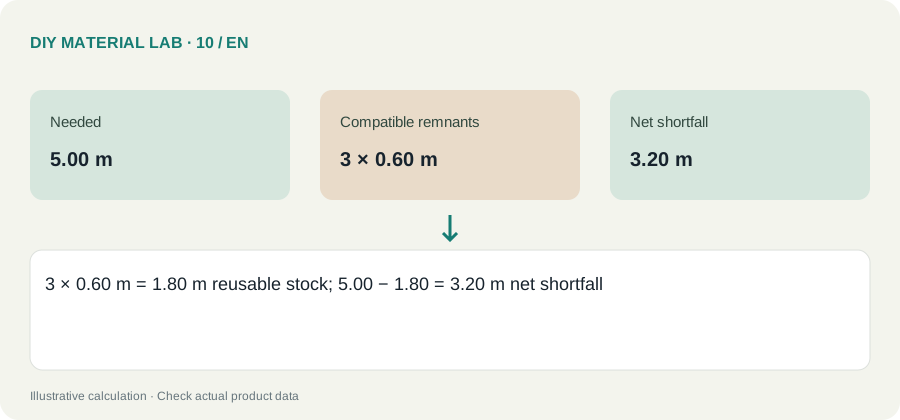
Use these inputs to follow the calculation. The result below explains what can and cannot be concluded from it.
| Needed | 5.00 m |
|---|---|
| Compatible remnants | 3 × 0.60 m |
| Net shortfall | 3.20 m |
The 1.8 m credit applies only if the project needs parts no longer than those remnants and the sections match. A single 1.2 m rail cannot be substituted by two 0.6 m offcuts without redesigning the joint.
Compare the scenarios
The following comparison isolates the quantities or assumptions discussed in the example. It is a planning illustration, not measured performance data.
Values are calculated from the illustrative inputs above. Different products or dimensions change the result.
Planning checklist
- Measure the actual project and record the units next to every dimension. Identify the regions or parts counted so nothing is included twice.
- Confirm the exact material format and its product instructions. Replace the example inputs with declared dimensions, coverage or yield from your chosen product.
- Calculate the net requirement first. Show cutting or application allowance separately and check whether the example method fits your geometry.
- Convert to whole supplier units once, then price the complete order including compatible accessories, delivery and any separately specified repair stock.
Mistakes to avoid
Do not mix millimetres and metres in the same multiplication. Do not apply a reserve twice, and do not treat a rounded purchase unit as proof that every part fits. Recheck the specific limitation described in the worked example before paying for the order.
Questions and answers
Can I copy the example quantities directly?
No. The examples demonstrate the calculation, not your exact room, layout or product. Replace the inputs and check the specific limitation explained with the result.
What should I verify before ordering?
The 1.8 m credit applies only if the project needs parts no longer than those remnants and the sections match. A single 1.2 m rail cannot be substituted by two 0.6 m offcuts without redesigning the joint.