Costs & shopping
Waste percentage and purchase allowance are different
The phrase ten percent waste can refer to two different denominators. An allowance adds a percentage of net demand.

Understand the requirement
The phrase ten percent waste can refer to two different denominators. An allowance adds a percentage of net demand. A loss rate describes the fraction of purchased material that does not become useful work. State the denominator whenever comparing projects; otherwise two apparently equal percentages produce different orders.
Choose the right calculation
For allowance a, purchase net × (1 + a). For an expected loss fraction r of the purchase, use net / (1 − r). Whole-pack rounding happens after either calculation. Reusable remnants and maintenance stock should be recorded separately, so a high unused fraction is not automatically interpreted as avoidable rubbish.
Check the product and the order
A price comparison is reliable only when the scope is the same. Note whether tax, transport, accessories and labour are included, and use dated quotations instead of example prices. Money held for contingency is not automatically an instruction to buy more material. Keep changes in scope visible so a revised total can be reconciled with the original plan.
Worked example
A transparent planning example
Use these inputs to follow the calculation. The result below explains what can and cannot be concluded from it.
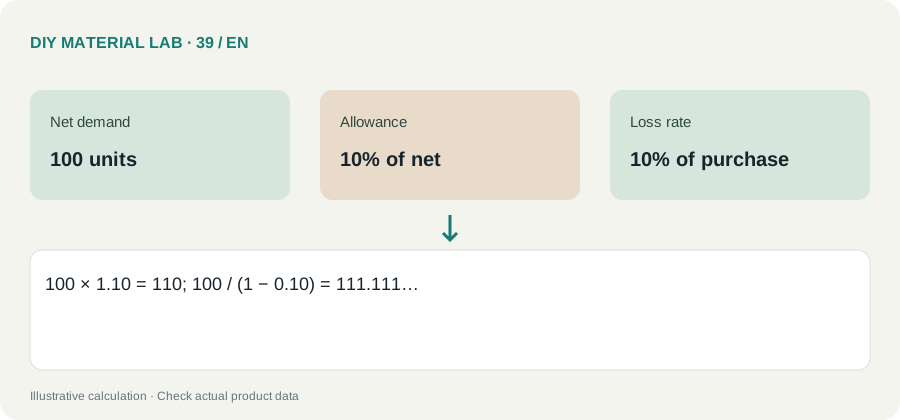
| Net demand | 100 units |
|---|---|
| Allowance | 10% of net |
| Loss rate | 10% of purchase |
A 10% net allowance leaves 10 units out of 110 unused: a 9.09% loss rate. A genuine 10% purchase loss needs 111.11 units before rounding. The distinction matters particularly when reserve assumptions become large.
Compare the scenarios
The following comparison isolates the quantities or assumptions discussed in the example. It is a planning illustration, not measured performance data.
Values are calculated from the illustrative inputs above. Different products or dimensions change the result.
Planning checklist
- Measure the actual project and record the units next to every dimension. Identify the regions or parts counted so nothing is included twice.
- Confirm the exact material format and its product instructions. Replace the example inputs with declared dimensions, coverage or yield from your chosen product.
- Calculate the net requirement first. Show cutting or application allowance separately and check whether the example method fits your geometry.
- Convert to whole supplier units once, then price the complete order including compatible accessories, delivery and any separately specified repair stock.
Mistakes to avoid
Do not mix millimetres and metres in the same multiplication. Do not apply a reserve twice, and do not treat a rounded purchase unit as proof that every part fits. Recheck the specific limitation described in the worked example before paying for the order.
Questions and answers
Can I copy the example quantities directly?
No. The examples demonstrate the calculation, not your exact room, layout or product. Replace the inputs and check the specific limitation explained with the result.
What should I verify before ordering?
A 10% net allowance leaves 10 units out of 110 unused: a 9.09% loss rate. A genuine 10% purchase loss needs 111.11 units before rounding. The distinction matters particularly when reserve assumptions become large.